1860
Rev. Isaac M. Westfall of Lafayette, Indiana, preached the first Universalist sermon in Olmsted County. Families attending the services in these early days drove in from area farms. Meetings were held in a frame building on Broadway known first as Compton’s and later as Porter Hall. The same building was used as a public school. Rev. Westfall moved on after three years and Universalist meetings were suspended.
1866
Rev. Silas Wakefield of Elkader, Iowa, was called to serve a newly formed congregation. A small church was built on the current site of the Plummer building for $2,200 and was dedicated on November 21, 1866. Rev. Wakefield transferred to the Owatonna church in 1868.
1871
Rev. Eliza Tupper Wilkes, the church’s first female minister, was ordained in Rochester and served the church for three years before moving to Colorado to organize a Universalist church in Colorado Springs.
1877
Grace Church (Universalist) was built during the ministry of Rev. George Deere at a cost of $11,000 (excluding carpeting and upholstering). Horace Greely (an influential American journalist and political leader), having attended a lecture in Rochester, stayed over to attend the Universalist church on Sunday morning.
1889
The first pipe organ in Rochester was bought for Grace Church (Universalist) at a cost of $1800.
1894
On May 13 the church observed the 25th anniversary of the first Universalist service in Rochester. Membership was 175 people. Dr. William Worrall Mayo lived next door and he stated: “I find myself in rather peculiar, and for me, unusual surroundings, not being a member of any church but the large church whose temple is the universe and its canopy the blue heavens lighted by the stars. In religious matters, I am a sort of citizen of the world. I have respect for the religious life of all people…. It is of comparatively recent date that men dared express their ideas. The establishment of your church dates back less than 100 years, but the golden thread of universal salvation has passed down through the ages. For good men, it was hard to entertain the idea that a just God would burn people for all eternity because they knew nothing of him. Then came the idea that man’s character is formed for him and not by him, that our religion and our birthplace are mere matters of accidents. For this idea of universal salvation to all men your church has passed through much persecution and I believe today you are not classed as Christians. Strange idea that you should be denounced because it horrified you to think souls should be burned forever.”
1906
The city churches sponsored a revival under the direction of renowned evangelist Billy Sunday. The Tri-State Messenger newspaper reported: “A large tabernacle erected for the purpose is filled daily to hear the message. The Universalists were invited to join but declined because of Mr. Sunday’s virulent attacks on our faith at other places. Our special services will follow the revival by Mr. Sunday.”
1907
A parsonage was purchased in September for $3,450 on West 3rd Street.
1915
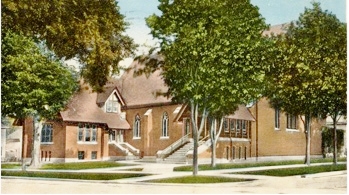
Grace Church (Universalist) was sold to Drs. William and Charles Mayo on July 19, 1915, and a new church was built at 3rd Ave and 3rd Street SW. The building cost $30,000 and the land cost $11,000.
1920
During the Great Depression the church experienced financial difficulties. The Rev. Owen Eames called for pledges to be increased or the church “will go down like a sinking ship.”
1930
Membership stood at 74 and the annual budget was just under $5000. The church received financial assistance of $300 from the Owatonna Universalist Church.
1940’s
When the Rev. Horton Colbert came in the fall of 1940, a new parsonage at 514 Seventh Ave SW was purchased. The Rev. Colbert and his successor, the Rev. George LaPoint, both had radio ministries in the community. Orvis Ross served as music director from the late 1940’s to the early 1970’s. Mr. Ross had a profound effect on the music program through his active participation as choral director, organist, pianist, composer and teacher. He wrote many original works for individual members, as well as for church services.
1950’s
Under the Rev. LaPoint’s leadership, the Beacon Curriculum of the Universalist Church was installed in the religious education program. A mural project depicting the curriculum themes of the church school program was initiated and completed. Members paid for nine paintings by William Saltzman for the church school rooms.
1961
Member Alicia Clagget helped the denomination secure property on Star Island at Cass Lake in Northern Minnesota. This property later became the home of Camp Unistar.
1962
The church formally changed its name to First Unitarian Universalist Church to recognize the 1961 national merger of the Unitarian and Universalist denominations.
1965
The congregation raised funds to send the Rev. Vernon Curry, minister at that time, to Selma, Alabama, to take part in civil rights marches. Also that year Sue Bateman was employed as the first paid director of religious education.
The church property was sold to the Mayo Foundation for $200,000. Five and one-half acres of wooded hillside were purchased on the frontage road west of Hwy 52. Stained glass windows were saved from the old church and are a highlight of the current church building.
1968
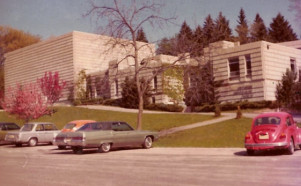
The new building (our current home) was occupied in March of this year.
1973-83
Under the leadership of the Rev. Alexander “Scotty” Meek, Jr., the church initiated a parent cooperative nursery school for the community, began holding forums on matters of public interest, paid off the building mortgage, built an 18th century reproduction harpsichord, and sponsored the resettlement of a Vietnamese refugee family. In 1983 the annual meeting of the Prairie Star District was hosted by the congregation.
Merrill N. Davis served as director of music from the early 1970’s to 1984. During this time, the church installed our Hendrickson tracker organ, which was a gift from Mary Kahler Hench. In addition, members of our congregation built a reproduction of an 18th century Flemish style harpsichord, which remains the finest instrument of its kind in our area.
1984
Kevin Dobbe served as our music director from 1984 to 1993. He continued the tradition of an active music program with the creation of the Walden Hill Vocal Ensemble, Children’s Choir, Hand Bell Choir, and Young Musicians program. He also composed our “Children’s Benediction.”
1985
The church called the Rev. Fred F. Campbell as minister. The concept of the Caring Congregation was developed, which helped provide volunteer assistance to members in times of crisis and need. Deep Ecology was studied by adult education classes. This period was marked by extensive building improvements, the founding of a chamber concert series, the revival of the popular Boar’s Head Feast, and plans for a memorial garden. Summer lay-led services were initiated and organized by the Rev. Campbell and the Religious Services Committee.
1987
Church member Erv Miller was elected to the Unitarian Universalist Board of Trustees, representing the Prairie Star and Western Canada Districts.
1990-92
The Rev. Campbell left and the Rev. John S. Gilbert was called to serve as interim minister.
During 1991-92 the church celebrated its 125th anniversary. The celebration began with a sermon by the Rev. John Cummins, Minister Emeritus of First Universalist, Minneapolis, and concluded with a two-day visit and Sunday service by the Rev. Dr. William F. Schultz, President of the Unitarian Universalist Association. Special music was composed by music director Kevin Dobbe. Membership was approximately 200, with a Sunday school attendance of 100.
1992
The congregation called the Rev. Dillman Baker Sorrells to be its minister and she was installed in April 1993.
1993
Due to the growth in church membership, two identical Sunday services were held on most Sundays during the church year.
We hosted the Prairie Star District annual meeting in April, which included a lecture by the Rev. Gordan McKeeman (who moved to Rochester and joined our congregation in 2010) on “Our UU Heritage.” Attendees were invited to join us for the installation of Rev. Sorrells on the final afternoon of the conference.
1993-2000
Laurie Helmers served as our music director. She successfully negotiated the transition to two Sunday services, brought more diversity in musical genre to our services, and drew on the talents of our members to increase congregational participation in our services.
1995
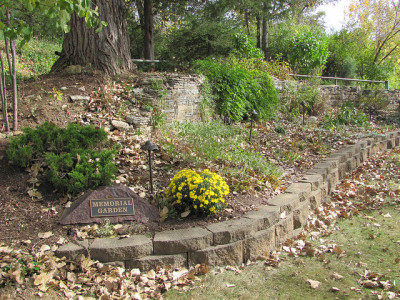
The Memorial Garden was dedicated this year thanks to the work and diligence of many members of the congregation.
1999
A million-dollar renovation project improved the church building in several ways. A new elevator made all four levels of the building accessible. A larger entrance and revised approach to the building made the entire area more appealing. Significant refurbishing made the interior more attractive. Several silk banners were made to decorate the auditorium; new display cases were installed to showcase collections of church documents; and space was created for historical photographs and other art.
2001
The congregation officially became a Welcoming Congregation.
Joe Mish and Kathy Shepel joined the staff as co-directors of music. Joe took responsibility for our choirs and Kathy took responsibility for guest musicians and overall coordination of the music program. Joe and Kathy began the practice of regularly creating services that are entirely led by the music program.
2003
Once again our church hosted the Prairie Star District annual conference. Approximately 250 UUs from 2 countries, 10 states, and 90 cities gathered in Rochester for a weekend of education, networking, and celebration.
2004
In 2004 Connie Schuelka replaced Kathy Shepel as co-director of music. For many years Connie had been, and continues to be, our dedicated and talented pianist and organist who plays at about ¾ of our services during the year.
2005
Reverend Sorrells announced her retirement as of August 1, 2005, and at the annual meeting she was bestowed the title Minister Emerita. The Rev. Sue Turner was called as an interim minister and served for one year.
2006
The congregation called the Rev. Dr. Carol Hepokoski to be its new minister, and she was installed in April 2007.
2008
A two-day Social Justice Empowerment Workshop was attended by 100 congregation members and friends. As a result, several tasks groups were formed to address social justice issues—poverty, racism, disabilities, health care, the environment, international justice, and gay, lesbian, bisexual, transgender (GLBT) rights.
2010
A Congregational Resolutions Task Force developed a recommendation for an inclusive and democratic process for our congregation to use when considering congregational resolutions on topics of social justice. This process and accompanying bylaw changes were adopted by the congregation at the 2010 annual meeting.
2011
An appreciative inquiry process, begun in 2008, continued through the next three years and resulted in the development of visions and goals and, finally, a church mission statement approved at the 2011 annual meeting: to be a compassionate, welcoming community that nurtures spiritual growth and practices justice.
The congregation was the recipient of the Bennett Award for Congregational Action on Human Justice and Social Action, an award given by the UUA that honors one congregation each year for its social justice work. Our church was recognized for this award at the UUA General Assembly in June 2011.
We established the Sophia Lyon Fahs Library in the former nursery, and created our first week-long Chalice Camp.
2012
In April, we passed our first Congregational Resolution, the Congregational Resolution for Marriage Equality.
2013
The Walden Hill Youth Group took a Heritage trip to Boston with our DRE, Ryan Shriver.
2014
With the help of a landscape architect and a master gardener, we created a rain garden in front of our church to prevent run-off into our parking lot.
2015
In April, we ordained church member the Rev. David Kraemer, the second minister to be ordained at our church.
In May Rev. Hepokoski retired, and we called Rev. Fritz Hudson as Interim Minister.
We spent a year celebrating our church’s 150th anniversary, culminating in April 2016 with the dedication of our new stained glass window, a banquet, and a Sunday sermon by UUA President Peter Morales.
2017
The congregation called the Rev. Luke Stevens-Royer to be our new minister, and he was installed in October 2017.
In October, the First UU Church of Rochester, MN attained certification through the Accessibility and Inclusion Ministry (AIM) Program, which enables Unitarian Universalist congregations to be formally recognized for their commitment and progress. We are only the fourth congregation in the country to receive the distinction of having attained AIM certification.
In October, we passed our second Congregational Resolution addressing immigrant rights and sanctuary.

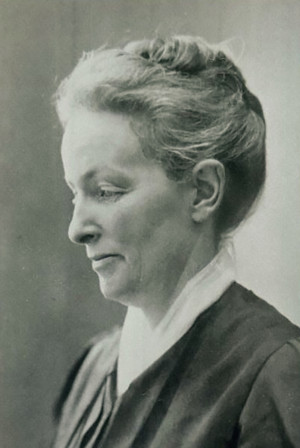

 1871 Rev. Eliza Tupper Wilkes, the church’s first female minister, was ordained in Rochester and served the church for three years before moving to Colorado to organize a Universalist church in Colorado Springs.
 1894 On May 13 the church observed the 25th anniversary of the first Universalist service in Rochester. Membership was 175 people. Dr. William Worrall Mayo lived next door and he stated:
“I find myself in rather peculiar, and for me, unusual surroundings, not being a member of any church but the large church whose temple is the universe and its canopy the blue heavens lighted by the stars. In religious matters, I am a sort of citizen of the world. I have respect for the religious life of all people…. It is of comparatively recent date that men dared express their ideas. The establishment of your church dates back less than 100 years, but the golden thread of universal salvation has passed down through the ages. For good men, it was hard to entertain the idea that a just God would burn people for all eternity because they knew nothing of him. Then came the idea that man’s character is formed for him and not by him, that our religion and our birthplace are mere matters of accidents. For this idea of universal salvation to all men your church has passed through much persecution and I believe today you are not classed as Christians. Strange idea that you should be denounced because it horrified you to think souls should be burned forever.”
1894 On May 13 the church observed the 25th anniversary of the first Universalist service in Rochester. Membership was 175 people. Dr. William Worrall Mayo lived next door and he stated:
“I find myself in rather peculiar, and for me, unusual surroundings, not being a member of any church but the large church whose temple is the universe and its canopy the blue heavens lighted by the stars. In religious matters, I am a sort of citizen of the world. I have respect for the religious life of all people…. It is of comparatively recent date that men dared express their ideas. The establishment of your church dates back less than 100 years, but the golden thread of universal salvation has passed down through the ages. For good men, it was hard to entertain the idea that a just God would burn people for all eternity because they knew nothing of him. Then came the idea that man’s character is formed for him and not by him, that our religion and our birthplace are mere matters of accidents. For this idea of universal salvation to all men your church has passed through much persecution and I believe today you are not classed as Christians. Strange idea that you should be denounced because it horrified you to think souls should be burned forever.” 1915 Grace Church (Universalist) was sold to Drs. William and Charles Mayo on July 19, 1915, and a new church was built at 3rd Ave and 3rd Street SW. The building cost $30,000 and the land cost $11,000.
 1968 The new building (our current home) was occupied in March of this year.
 1995 The Memorial Garden was dedicated this year thanks to the work and diligence of many members of the congregation.